# Security settings

{% hint style="info" %}
Available in the **Premium** plan or higher
{% endhint %}

## Restrict access to a board

By default, a board is public, and anyone with the link can access it. You can change this behavior through the security settings.

<figure><img src="/files/OcxpcQM3XfO9zZ3Oy9aw" alt=""><figcaption><p>Security settings for a public kanban board</p></figcaption></figure>

In certain situations, you may need to restrict access to the board. In these cases, you can limit access by allowing only specific domains, ensuring the board remains private.

### Allowed domains

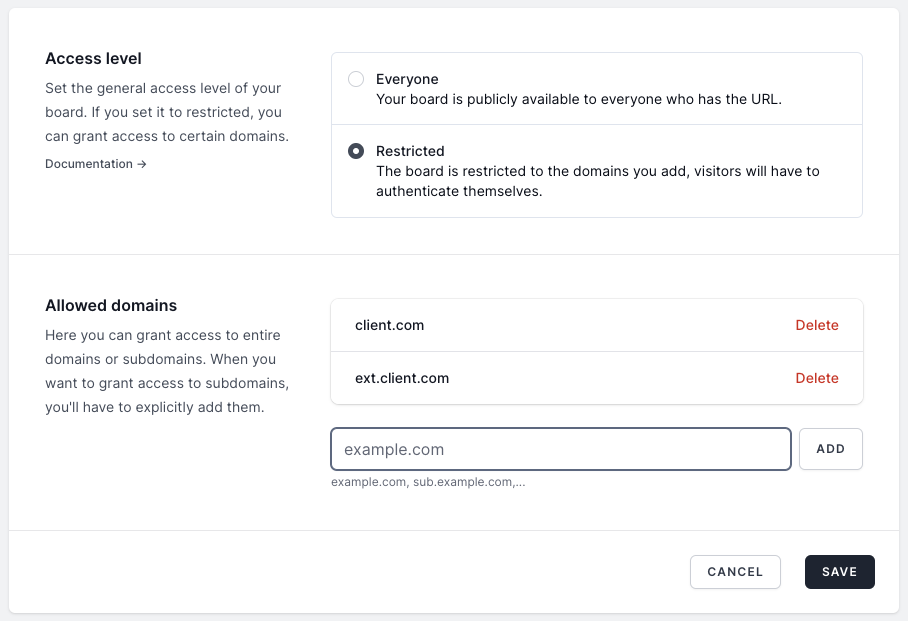
Instead of adding all stakeholders from your client as individual users, you can simply add "client.com" as allowed domain. This way, anyone with an email ending in "@client.com" will automatically gain access.

If your stakeholder uses subdomains, like "<name@ext.client.com>" for external contractors, they won't automatically gain access until you add the "ext.client.com" as an allowed domain.

<figure><img src="/files/RIWg7ZdRuNQH1pPkRh6V" alt=""><figcaption><p>Security settings for a restricted kanban board</p></figcaption></figure>

### Accessing a restricted board

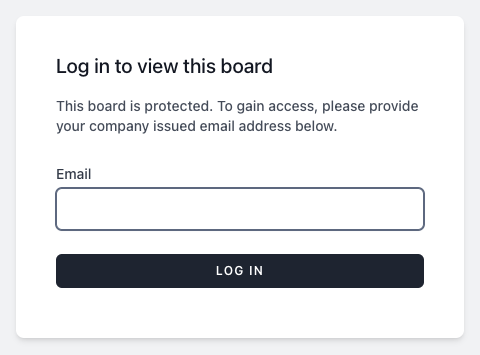
You can still share a restricted board through the same URL. When accessed by an anonymous visitor, a login prompt will be shown.

<figure><img src="/files/5kOnnIKYwFAc8Cqw2fHw" alt=""><figcaption><p>Login screen for a restricted kanban board</p></figcaption></figure>

Stakeholders will be able to log in through a magic link, only if their domain is added to the allowed domains list. Upon their first visit, an account will be created for them automatically.

If the stakeholder is a Publicboards user, such as yourself, they will be redirected to the default login screen of Publicboards.

## Permissions

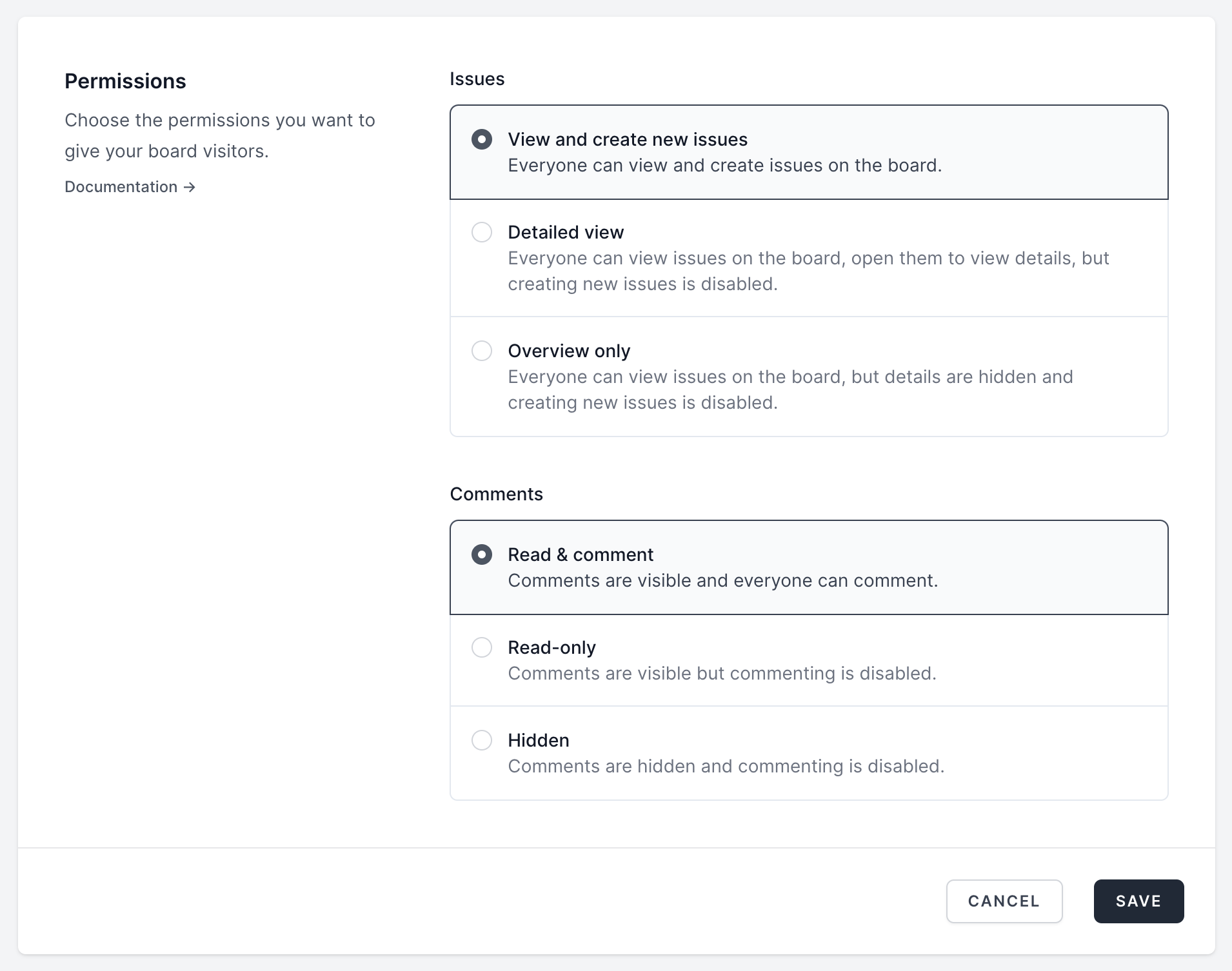
You can choose the permissions a visitor has. Everyone who has access to the board has the same permissions.

<figure><img src="/files/j2rAYnqrjpprGkoLjMnv" alt=""><figcaption><p>Permission settings for a public kanban board</p></figcaption></figure>

### Issues

This defines what permissions a board visitor has towards issues that are being loaded on the board:

<table><thead><tr><th width="296">Setting</th><th data-type="checkbox">View board</th><th data-type="checkbox">Open issue details</th><th data-type="checkbox">Create new issues</th></tr></thead><tbody><tr><td><ol><li>View and create new issues</li></ol></td><td>true</td><td>true</td><td>true</td></tr><tr><td><ol start="2"><li>Detailed view</li></ol></td><td>true</td><td>true</td><td>false</td></tr><tr><td><ol start="3"><li>Overview only</li></ol></td><td>true</td><td>false</td><td>false</td></tr></tbody></table>

### Comments

This defines what permissions a board visitor has towards comments on the issues:

<table><thead><tr><th width="294">Setting</th><th data-type="checkbox">Read comments</th><th data-type="checkbox">Add comments</th></tr></thead><tbody><tr><td><ol><li>Read &#x26; comment</li></ol></td><td>true</td><td>true</td></tr><tr><td><ol start="2"><li>Read-only</li></ol></td><td>true</td><td>false</td></tr><tr><td><ol start="3"><li>Hidden</li></ol></td><td>false</td><td>false</td></tr></tbody></table>


---

# Agent Instructions: Querying This Documentation

If you need additional information that is not directly available in this page, you can query the documentation dynamically by asking a question.

Perform an HTTP GET request on the current page URL with the `ask` query parameter:

```
GET https://docs.publicboards.com/boards/kanban-board/security-settings.md?ask=<question>
```

The question should be specific, self-contained, and written in natural language.
The response will contain a direct answer to the question and relevant excerpts and sources from the documentation.

Use this mechanism when the answer is not explicitly present in the current page, you need clarification or additional context, or you want to retrieve related documentation sections.